Dr. Muhammad Rehman (Policy Analyst)
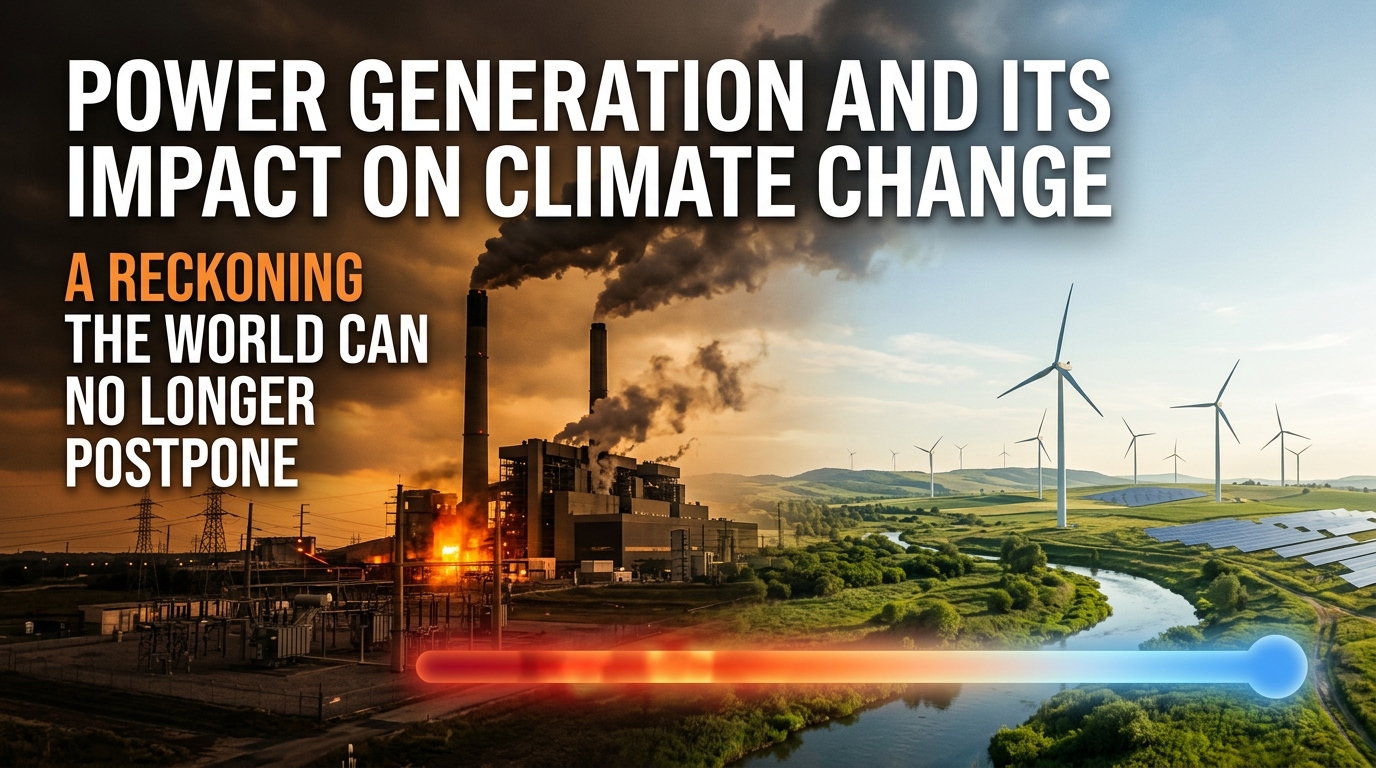
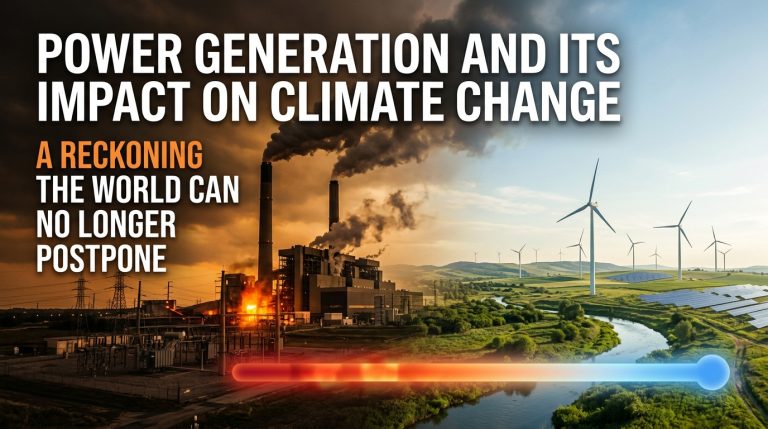
Climate change has emerged as one of the defining challenges of our contemporary world. Rapid industrialisation, rising global temperatures, increasing carbon emissions, and growing frequency of floods are reshaping the world we live in. At the same time, the world’s dynamics are changing so fast due to increasing demand of electricity and power generation, as well as the need to protect the environment. However, power generation through fossil fuels is placing significant pressure on the natural environment by increasing greenhouse gas emissions (GHGs). This environmental degradation is creating serious consequences not only for the world’s ecosystems and natural resources but also for human health, livelihoods, and overall well-being.
Power Generation Is Being Rewired in Real Time
The way the world generates electricity is undergoing the fastest structural shift in power generation in a century.
Yet, most people have not fully recognized how far this transformation has already progressed. Demand of electricity is ubiquitous in modern times but transformation adopts conservative approach for power generation. In 2024, renewable sources supplied the largest share of growth in global energy supply at 38%, ahead of natural gas, coal, oil and nuclear combined. More strikingly, renewables and nuclear together accounted for 80% of the growth in global electricity generation, crossing 40% of total generation for the first time, with renewables alone supplying 32%. In 2025, solar photovoltaic technology led renewable energy expansion, as nearly 700 GW of renewable capacity was added worldwide. Solar PV accounted for almost 80% of this new renewable capacity. By 2025, renewables are on track to overtake coal as the single largest source of electricity, pushing coal’s share below 33% for the first time in a hundred years.
This is not a marginal green trend at the edges of the power sector. It is a transformation of the sector’s core architecture. The system is shifting from large, centralized fossil-fuel plants toward distributed, weather-dependent, low-carbon sources of electricity.
But the transformation is uneven, and that unevenness is where the real story lies. Even as solar and wind break records, global electricity demand surged by 4.3% in 2024. Demand growth outpaced GDP growth, driven by heatwaves, electrification, and the rapid expansion of data centers. This raises an important question that policymakers, engineers, and economists have yet to fully answer. How does fossil-fuel-based power generation drive climate change? What does empirical evidence reveal about its actual impact?
The Power Generation Mechanism Is Old. The Evidence Is Overwhelming.
Fossil-fuel power plants generate electricity by burning coal, oil, and natural gas to produce heat, which turns water into steam, which spins a turbine. That combustion releases carbon dioxide and other greenhouse gases that trap heat in the atmosphere; the basic physics has not changed since the nineteenth century.
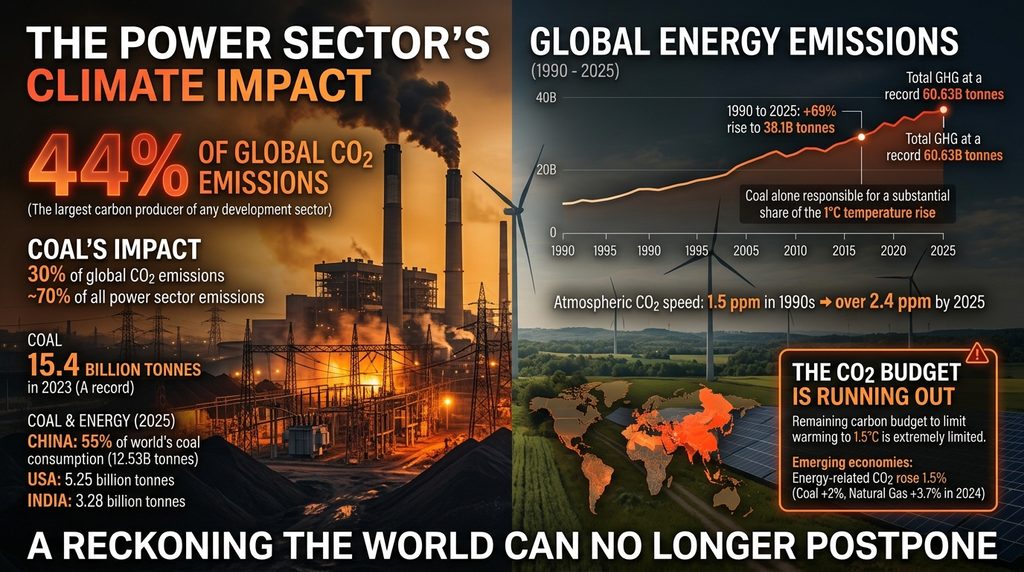
What has changed is the scale. The power sector alone is responsible for approximately 44% of global CO2 emissions. This makes the power sector exceptional as the largest carbon producer compared to any other development sector. The IPCC (Intergovernmental Panel on Climate Change) assessment is remarkable on these points. First point: fossil fuel combustion is the dominant driver of observed global warming. The Second Point: coal on its own has been responsible for a substantial share of the roughly 1°C temperature rise. The planet has already experienced the temperature keep climbing rather than falling.
CO2 Emission and Coal Power Plants
Coal is the world’s largest single source of CO2, accounting for approximately 30% of the world’s total CO2 emissions and ~70% of all emissions in the power sector. In 2023, CO2 emissions from coal combustion amounted to a record 15.4 billion tonnes of CO2. In 2025, China remained the world’s largest coal consumer for power generation. China accounted for more than half of global coal consumption, burning approximately 55% of the world’s coal. China’s economy-wide emissions now approach a third of global emissions, at 12.53 billion tonnes in 2025.
The United States and India account for approximately 5.25 billion and 3.28 billion tonnes, respectively, together contributing nearly 8.53 billion tonnes. Global CO2 emissions from energy consumption continued to rise, not fall. Between 1990 and 2025, global fossil fuel emissions rose by roughly 69% to reach 38.1 billion tonnes, driving total greenhouse gases up to a record 60.63 billion tonnes. This surge nearly doubled the pace of atmospheric damage, accelerating the annual accumulation speed of CO₂ from 1.5 parts per million in the 1990s to over 2.4 parts per million by 2025.
According to the Global Carbon Project’s latest budget, fossil-fuel and cement emissions could reach 38.1 billion tonnes of CO2 in 2025. The remaining carbon budget for limiting warming to 1.5°C has now become extremely limited. Developing countries show an even sharper trend in fossil fuel dependence. Energy-related CO2 emissions in emerging and developing economies rose by 1.5% in 2024. Coal emissions increased by 2% and natural gas emissions rose by 3.7%. These increases reflect continued reliance on fossil fuels to meet fast-growing energy demand.
Case Study of India
India provides a useful case study. Record heatwaves sharply increased electricity demand for cooling. Power producers responded by burning more fossil fuel to meet the additional demand. This increased carbon dioxide emissions by roughly 50 million tonnes. That increase accounted for about one-third of the country’s total emissions growth that year. This empirical cycle concerns economists and climate scientists. Warm weather increases electricity demand for domestic electric gadgets. Fast-growing economies as well as developing economies often meet this demand with additional fossil-fuel generation. The emissions further increase global temperatures, reinforcing the cycle.
Top Six Countries- GHG Emissions
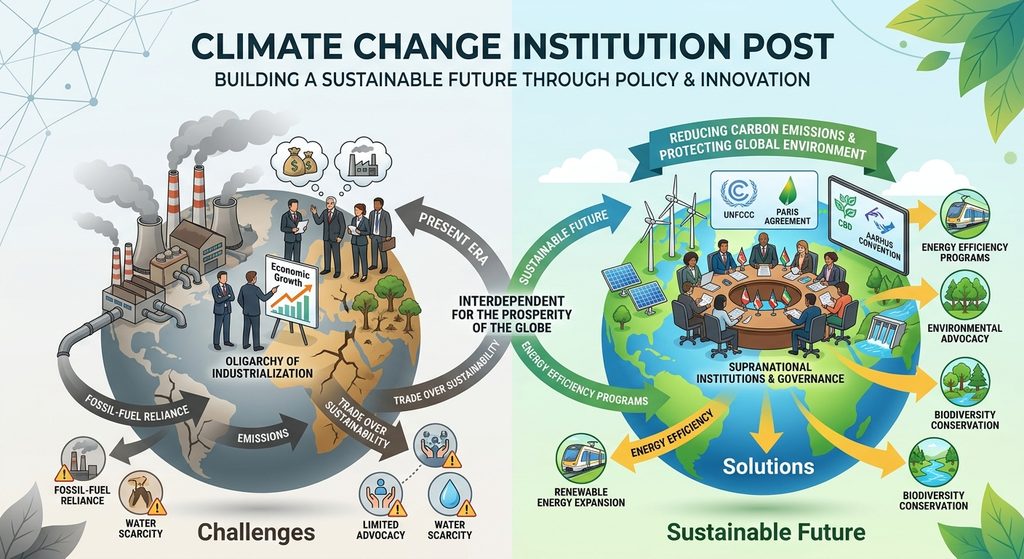
Industrial countries around the world release more greenhouse gases (GHG), supranational institutions impose sanctions through their policies and good practices. As a result, almost every country around the world has engaged in environmental collaborative efforts under the umbrella of environmental treaties such as the United Nations Framework Convention on Climate Change (UNFCCC), Paris Agreement (PA), Convention on Biological Diversity (CBD), and Aarhus Convention.
In 2024, global GHG emissions of 53,206.40 million tonnes of CO2 equivalent are borne by six countries. At 15,536.10 Mt CO2eq, China is far ahead of all other countries, accounting for almost 29.2% of the global total. The United States is at 5,912.62 Mt, accounting for 11.11% of the global emissions. India is at 4,371.17 Mt, or 8.22% of emissions. Russia comes next at 2,575.65 Mt (4.84%), and the EU27 bloc together adds 3,164.66 Mt (5.95%). With about half of the planet’s population, the 6 top emitters combine to emit more than 60% of the planet’s emissions, which adds up to a total of 1,323.78 Mt. By comparison, in 2024 Pakistan emitted 525.88 Mt, an amount that was 0.99% of the global total, but has increased over the past 30 years, more than two and a half times from 188.88 Mt in 1990.
Global Governance Balances and Economic Growth- Environmental Sustainability
The revolutionary concept implemented by policymakers to protect the environment and exponentially increase economic growth thus the emerging revolutionary idea is global governance. Under global environmental protection strategies, supranational institutions have established governance mechanisms to promote environmental sustainability. These institutions include UNEP, IPCC, World Bank- environmental, Natural Resources and Blue Economy, Green Climate Fund (GCF), IUCN and Global Environmental Facility (GEF). These supranational institutions collaborate to economic policies and best practices, and these institutions contribute to global environmental protection and sustainability without harming the economic growth of the world.
In the present era, globalization, economic growth, and environmental sustainability are interdependent for the prosperity of the globe. There are multiple policies, programs, and strategies to reduce carbon emissions and protect the global environment, such as United Nations Framework Convention on Climate Change (UNFCCC), the Paris Agreement (PA), the Convention on Biological Diversity (CBD) and the Aarhus Convention that are implemented to protect environmental sustainability. International policymakers can adopt multiple best practices to promote environmental sustainability. These practices must be implemented through the formation of supranational institutions, such as reducing fossil-fuel an expending renewable energy sources. Governments can also improve energy efficiency through targeted programs and profound environmental advocacy. They can promote hybrid transportation systems and strengthen water and biodiversity conservation. On the other side oligarchy of the industrialization sector focuses more on economic growth, trade, and production instead of adopting best practices in their sector.
Pakistan Is Living This Crisis, Not Just Studying It
Nowhere is this loop more visible, or more punishing, than in Pakistan. In 2026, approximately 49.2% of Pakistan’s installed power capacity still runs on fossil fuels. Mostly, CPEC Power Generation Plants generate electricity through imported gas and coal. In 2026, Pakistan’s Power Generation Capacity has reached 49,651 MW. Whether measured by installed capacity or actual generation, international energy institutions classify these plants as carbon producers. Such institutional classification creates additional challenges for Pakistan’s energy transition and economic planning. This dependence also poses serious economic exposure for Pakistan. Fuel imports consume nearly 30% of Pakistan’s foreign exchange earnings. Meanwhile, the power sector faces a circular debt burden running into trillions of rupees. The circular debt increased by Rs. 364 billion, further intensifying pressure on the power sector. This disastrous tariff cycle discourages industrial investment. It also places additional financial pressure on households already struggling with inflation.
Pakistan Contributes Less than 1% of Global Emissions
Pakistan contributes less than 1% of global greenhouse gas emissions. Yet it remains highly exposed to climate-related and extreme weather events. International climate-risk indices consistently place it among the ten to fifteen most climate-vulnerable countries on earth. This ranking is earned through repeated catastrophic flooding, glacial melt, and heat extremes. In the context of global climate vulnerability indices, Pakistan is facing an extremely critical situation. Germany’s Germanwatch Climate Risk Index (CRI) ranked Pakistan first among the countries most affected by extreme weather in 2022. This Ranking reflected the severe human and economic losses caused by Pakistan’s catastrophic floods in 2022. In long-term climate vulnerability indexes over the last 30 years, the country’s rank has always been 5th in the world. This vulnerability is compared to Pakistan’s carbon footprint, which is less than 0.9% of global GHG emissions.
The World Bank’s Country Climate Assessment describes climate change as a “risk multiplier” for Pakistan. It threatens the country’s broader macroeconomic outlook rather than remaining a separate environmental issue. Insurance and reinsurance markets have also begun repricing Pakistan’s climate-related risks. Repeated flood losses are raising the cost of catastrophe insurance for industries and infrastructure. Trade policy is creating another challenge for Pakistan’s export-oriented economy. The European Union’s Carbon Border Adjustment Mechanism will eventually cover additional carbon-intensive products. This could affect Pakistan’s textile exports, a major source of foreign exchange earnings. One estimate projects export losses exceeding $308 million, potentially reaching $479 million by 2036. The impact would be concentrated mainly in industrial and agricultural goods. The EU absorbs nearly 30% of Pakistan’s textile exports. Therefore, carbon-based trade rules could increase pressure on Pakistan’s fossil-fuel-dependent energy system.
Renewable Power Generation Policies in Pakistan
The 37th meeting of the Council of Common Interests (CCI) in April 2018, chaired by the PM of Pakistan, formally accepted the policy. Alternative and Renewable Energy Policy (2019) replaces the Pakistan Renewable Energy Policy 2006. Pakistan’s energy strategy changes in order to shift towards clean, sustainable, and affordable energy. While the policy primarily focuses on solar, wind, and biomass energy, it also includes small and medium-sized hydropower projects. The private power generation sector can undertake these hydropower projects under the policy, as they operate as Independent Power Producers (IPPs).
The policy aims to achieve a 30% renewable energy share in the national grid by 2030. The target rises to 60% when large hydropower projects are included. The policy promotes open markets, competition, and transparent tariffs to attract private investors. These hydropower plants in Pakistan — Suki Kinari (870 MW), Karot (720 MW), and Azad Pattan (700 MW) – are part of CPEC. These projects also received IPP financing and tariff guarantees under the ARE policy framework. Therefore, the ARE Policy 2019 supports the existing energy policy and helps form Public-Private Partnerships (PPPs) for hydropower projects in inaccessible or off-grid rural areas, all in line with global climate and SDG 7 goals.
What Policy Design Actually Has to Do
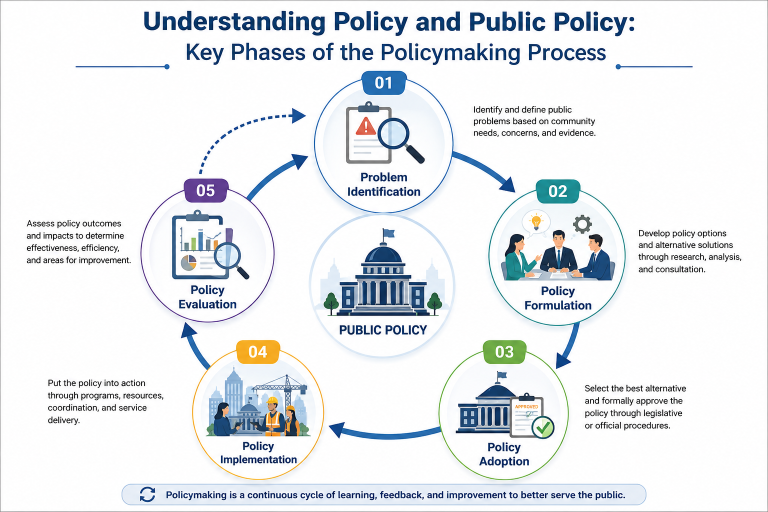
None of this can be fixed by intention alone; it requires policy architecture that closes the gap between commitments on paper and capacity on the ground. Pakistan’s updated Nationally Determined Contribution (NDC) pledges to cut emissions by up to 50% by 2035 against a business-as-usual baseline, but a third of that reduction is explicitly conditional on receiving international climate finance that has historically arrived late or fallen short of pledges. So the real policy question is this: what does an energy and climate policy framework need to contain to actually deliver a lower-carbon, more resilient grid rather than another aspirational document?
The answer has to combine four elements working together rather than in isolation. First, pricing signals: A domestic carbon pricing or emissions-trading mechanism gives industry a reason to decarbonize ahead of CBAM deadlines rather than in reaction to them.
Second, grid and market reform: Pakistan is adding renewable capacity, but weak transmission limits its effective use. The country needs stronger transmission networks, greater storage investment, and reform of take-or-pay contracts with independent power producers. These reforms can improve renewable power dispatch efficiency and reduce the accumulation of circular debt.
Third, blended finance: Pakistan has limited sovereign borrowing capacity, which restricts public investment in clean energy. Public climate funds should therefore reduce investment risks for private solar, wind, and storage projects. This approach can attract private capital rather than replace private investment.
Fourth, institutional accountability: Green budget tagging and disaster-risk budgeting require effective monitoring and enforcement. The IMF has included these reforms within its lending framework. An independent body should monitor implementation instead of leaving oversight to ministries with competing short-term priorities.
The Recommendation Is Not Complicated — Financing and Follow-Through Are the Bottleneck
Put plainly, the technology and the targets already exist; what is missing is sequencing and finance. Pakistan should prioritize repowering its existing gas fleet with efficiency upgrades while aggressively front-loading solar and wind additions, since these are now the cheapest new generation sources available globally and already made up close to a quarter of new capacity added in the past year through rooftop solar and net metering alone.
Government policy should lock in long-term power purchase agreements for renewables rather than fossil plants, restructure circular debt through targeted subsidy reform rather than blanket tariff hikes, and use its position among the world’s most climate-vulnerable nations to negotiate concessional — not just conditional — climate finance at COP and G20 forums. On the export side, industrial decarbonization support for textile manufacturers should be treated as trade policy, not just environmental policy, given how directly the Carbon Border Adjustment Mechanism (CBAM) threatens foreign exchange earnings. None of this is radical. It is closer to what every serious energy-transition economy, from Vietnam to Morocco, is already attempting with more consistency than Pakistan has managed so far.
A Question for the Institutions Setting the Rules
There is a final question worth putting directly to the international system that designed this architecture of climate finance, carbon pricing and trade penalties: if the World Bank, IMF, the EU and global insurers are willing to price climate risk into loans, tariffs and premiums for countries like Pakistan that contribute under 1% of global emissions, why does the $100 billion annual climate finance pledge made by the world’s largest historical emitters remain chronically underfunded and delayed, even as the countries paying the steepest price for a crisis they did not create are asked to reform first and wait for support later? Without addressing this gap, the Global South may view energy transition as a compliance obligation. Instead, international cooperation should treat energy transition as a shared global responsibility.
About Author
Dr. Muhammad Rehman is a policy analyst focused on global governance, energy policy, and Public-Private Partnership (PPP) mechanisms across sectoral development projects. He writes for Global Policies Analysis, examining how supranational institutions and policy frameworks shape development outcomes worldwide.
Disclaimer
The images on this page are created using Artificial Intelligence (AI) tools.
About the Author


Nice Collection ❤️Helping material
Nice Collection ❤️Helping material
Thanks
Worthy words great knowledge
Thanks
Thanks, sir. Appreciated.
Thank you for the information.
Grateful sir
Thanks
Very good article, great work sir
Thanks
Thanks, sir. I also accept criticism.