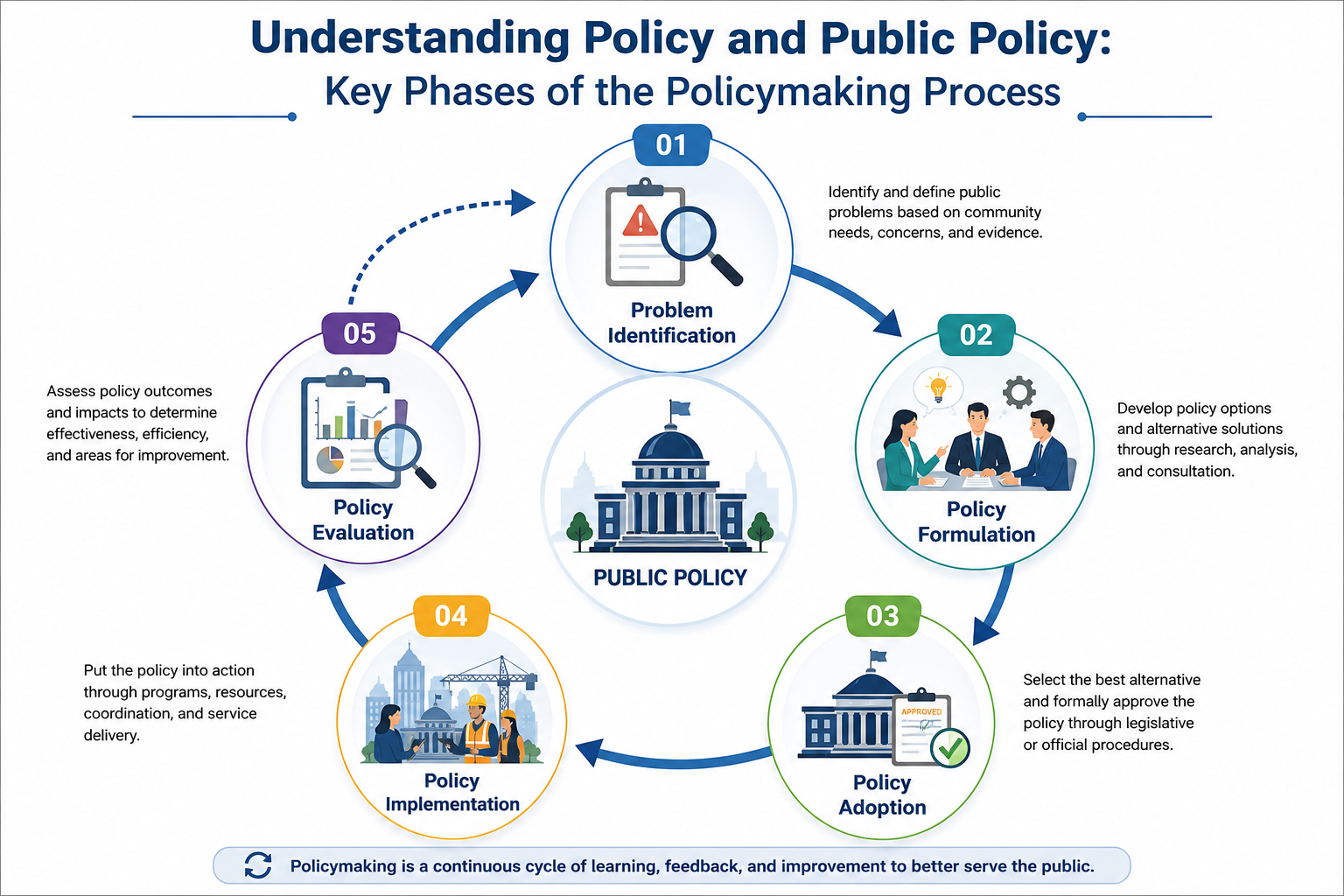
Understanding the public policy
Dr. Muhammad Rehman (Policy Analyst)
Policy is a broad statement of goals, objectives and guiding principles that create the framework for activity. Policies often take the form of explicit written documents, but they may also be implicit or unwritten. One of the leading scholars of political science, Harold Lasswell (1936), defined politics as the determination of “who gets what, when, and how”. Harold’s concept indicates that public policies allocate resources among different groups in society. Hence, a policy cannot be viewed simply as a regulation because it is an expression of intention which has force behind it.
James Anderson stated that public policy is a planned course of action adopted by actors to solve a public issue. David Easton further elaborates that public policy is an authoritative allocation of values for a society. Carl Friedrich defines public policy as a proposed course of action by a person, group, or government to address a particular situation, explore available possibilities, overcome barriers and achieve the desired goal.
Furthermore, Thomas Dye defines public policy in a simple term as “whatever government chooses to do or not to do”. Public policy is a subset of policy that specifically concerns decisions made by governmental authorities on behalf of the public. It is the primary tool through which governments translate political priorities into real-world actions that affect citizens’ lives. Public Policy includes Regulatory Policy (related to rules and regulations), Distributive Policy (related to the allocation of resources), Redistributive Policy (related to revenue and welfare programs), and Constituent Policy (related to governmental structure, such as institutional design and hierarchy).
Stakeholders and Policy Actors
Policy Actors
Policy actors are individuals, groups, or organizations that participate directly in the policy process. They contribute to one or more stages of policymaking, including agenda setting, policy formulation, decision-making, implementation, and evaluation. Policy actors may include government institutions, political leaders, bureaucrats, private-sector organizations, civil society organizations, international agencies, and advocacy groups.
Stakeholders
Stakeholders include individuals, groups, and organizations that affect policy directly or indirectly. Although they may not actively participate in the policymaking process, they have an interest in the policy outcomes because the policy influences their social, economic, political, or environmental conditions. Some stakeholders may also become policy actors when they engage in policy advocacy, consultation, or implementation.
In the policy process, stakeholders have an interest in the policy issue. They also include those affected by policy decisions and those who influence or participate in policy formulation and implementation. Therefore, while all policy actors are stakeholders, not all stakeholders are policy actors.
Types of Actors
Government actors include elected representatives, ministries, regulatory authorities, and public agencies. They develop and implement public policy.
International Actors are those who influence domestic and global policy, including international organizations, donor agencies, multinational institutions, and foreign governments. Non-state actors, also known as welfare actors, participate in the global policy process. They implement policies across the world. Non-state actors include non-governmental organisations (NGOs), Civil Society Organizations (CSOs), private companies, advocacy networks, professional associations, and the media. Interest groups are organizations that seek to influence public policy to advocate the interests of their members or constituents. Social movement actors involved in citizen groups or community-based movements that advocate for social, political, economic, or environmental change.
The policymaking process defines how policymakers initiate, formulate, negotiate, communicate, implement, adopt, and evaluate.
Five Phases of the Policymaking Process
• Problem Identification
• Policy Formulation
• Policy Adoption
• Policy Implementation
• Policy Evaluation
1. Problem Identification
A policy problem is an issue that demands government action because it affects the public interest. It represents the gap between the existing situation and the desired goals. Societies face many issues, but policymakers and the public recognize only important ones as policy problems. Examples include unemployment, inflation, climate change, inadequate healthcare, poor governance, and energy shortages.
How Does a Policy Problem Reach the Government Agenda?
Not every public issue becomes a government priority. A policy problem reaches the government agenda when it receives sufficient attention from policymakers, citizens, interest groups, civil society organizations, researchers, or the media.
How does it get on the Agenda of Governance?
Once an issue gains political recognition, it may proceed to the agenda-setting stage of the policy process. Agenda setting is the process through which governments determine which public issues deserve official attention and policy action. Since governments have limited resources and competing priorities, they cannot address every problem simultaneously. Therefore, agenda setting helps policymakers select the issues that require immediate consideration. In public policy, there are two types of agenda-setting: Systemic Agenda & Institutional Agenda.
Systemic Agenda
The systemic agenda includes all issues that members of the political community generally recognize as attracting public attention and falling within the government’s legitimate authority. Systematic-agenda adopts the bottom-up approach.
Institutional Agenda
The institutional agenda consists of problems that receive serious attention from decision-makers. However, decisionmakers do not always easily identified or agreed upon. Institutional-agenda adopts the top-down approach.
Getting from the Systemic to the Institutional Agenda
Power elites and pressure groups that are powerful in their own right have relatively little trouble getting their issues before the public. Similarly, media elites can shape public opinion by selecting the issues and stories that receive attention through television, newspapers, and other communication channels. Special interest groups also frequently approach the government with their judgmental views of the problem and proposed solutions.
2. Policy Formulation
Policy formulation is the development of effective and acceptable courses of action to address issues on the policy agenda. It is associated with the “what” question that generates alternative policy options.
• What is the plan for dealing with the problem?
• What are the goals and priorities?
• What options are available to achieve those goals?
• What are the costs and benefits of each of the options?
• What externalities, positive or negative, are associated with each alternative?
Selecting Alternatives
The formulation of a policy not only develops a policy document but also develops various policy alternatives to achieve the desired goals.
Rational analysis is a plan for achieving government efficiency through a comprehensive review of all the policy options and an examination of their consequences. Rational analysis of the budgetary process implies that each option be considered.
Incremental approach
Incrementalism is a decisionmaking approach in which policymakers modify existing policy marginally. They adopt the incremental approach rather than formulating a new policy.
3. Policy Adoption
Policy formulation develops multiple alternatives. During the policy adoption phase, policymakers chose the best alternative option that best meets the general public’s requirements and available budget. They also consider the social cost of each alternative before making a final decision that would not harm society. Sometimes the government choose policies that are socially sustainable or budget-friendly rather than economically rational because of their social costs.
4. Policy Implementation
Policy implementation means carrying out the policy in practice. It addresses the questions: What is done, if anything, to implement a policy, and what impact does this have on policy content?
Policy implementation is a continuation of policymaking process because the success of a policy depends not only on its formulation but also on its effective implementation. Implementation has attracted significant scholarly attention because many policies have failed to achieve their intended objectives despite being well designed.
5. Policy Evaluation
Policy evaluation is the process of assessing how effectively a policy or program achieves its intended goals and objectives.
All the earlier stages of the policy process focus on achieving future policy objectives. In contrast, policy evaluation looks back to examine the outcomes and determine whether the policy has achieved its intended results. The findings of policy evaluation provide valuable feedback to policymakers. This feedback helps identify strengths, weaknesses, and areas for improvement, allowing modifications to be made that enhance the policy’s efficiency and effectiveness.
David Easton’s Political System Model
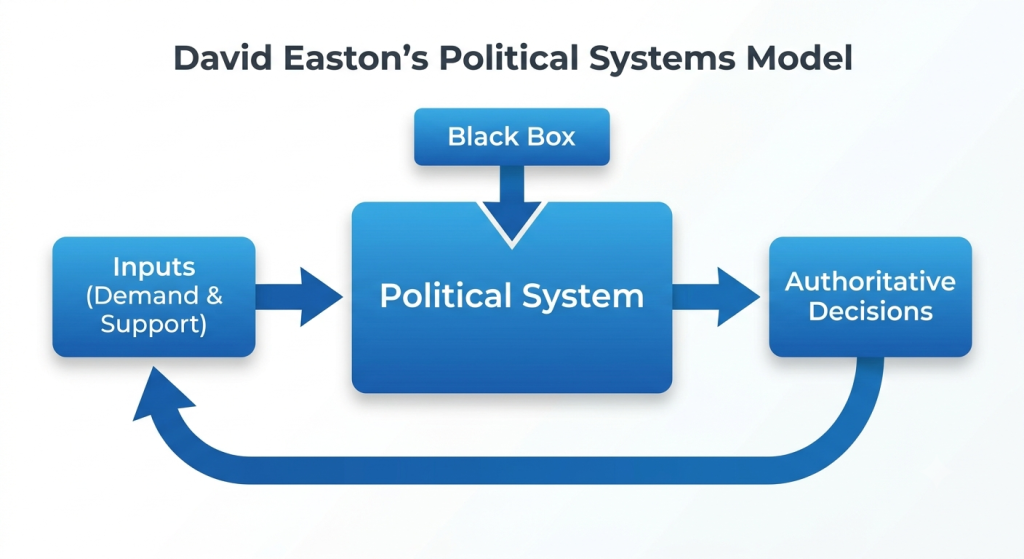
David Easton’s Political System Model explains policymaking as a process in which the public inputs their demands and support enter the political system. David Easton views the political system act as a black box where interest groups, political parties, and other actors shape public demands according to their own interests. The political system processes these inputs and produces policy outputs. The political system transforms public demands along their political interests into policy output, and public feedback influences future policy decisions. The concerned authorities then implement these outputs on the ground.
If people accept the policy output and believe that it is according to their demands, and give positive feedback to the government, this is called an active policy. On the other side, if the people believe that policy outputs are not matched with their demands, then people’s negative feedback influences the government to revise the policy, which is called a passive policy.
About Author
Dr. Muhammad Rehman has completed Ph.D in Governance and Public Policy at the National University of Modern Languages (NUML), Islamabad. His research interests include public policy, governance, sustainable development, global governance, environmental policy, and policy analysis. He regularly writes on contemporary governance challenges, sustainability issues, and public sector reforms, providing evidence-based insights for academics, policymakers, and practitioners.
About the Author


Hi, this is a comment.
To get started with moderating, editing, and deleting comments, please visit the Comments screen in the dashboard.
Commenter avatars come from Gravatar.
Hi, I have read your blog hydrogen economy. It is amazing
A well-written and thought-provoking piece. Really enjoyed reading this. The depth of research and thoughtful analysis make it both informative and engaging.Your ability to connect policy with real-world implications is truly commendable. Thank you for sharing such valuable perspectives. Looking forward to more articles like this!