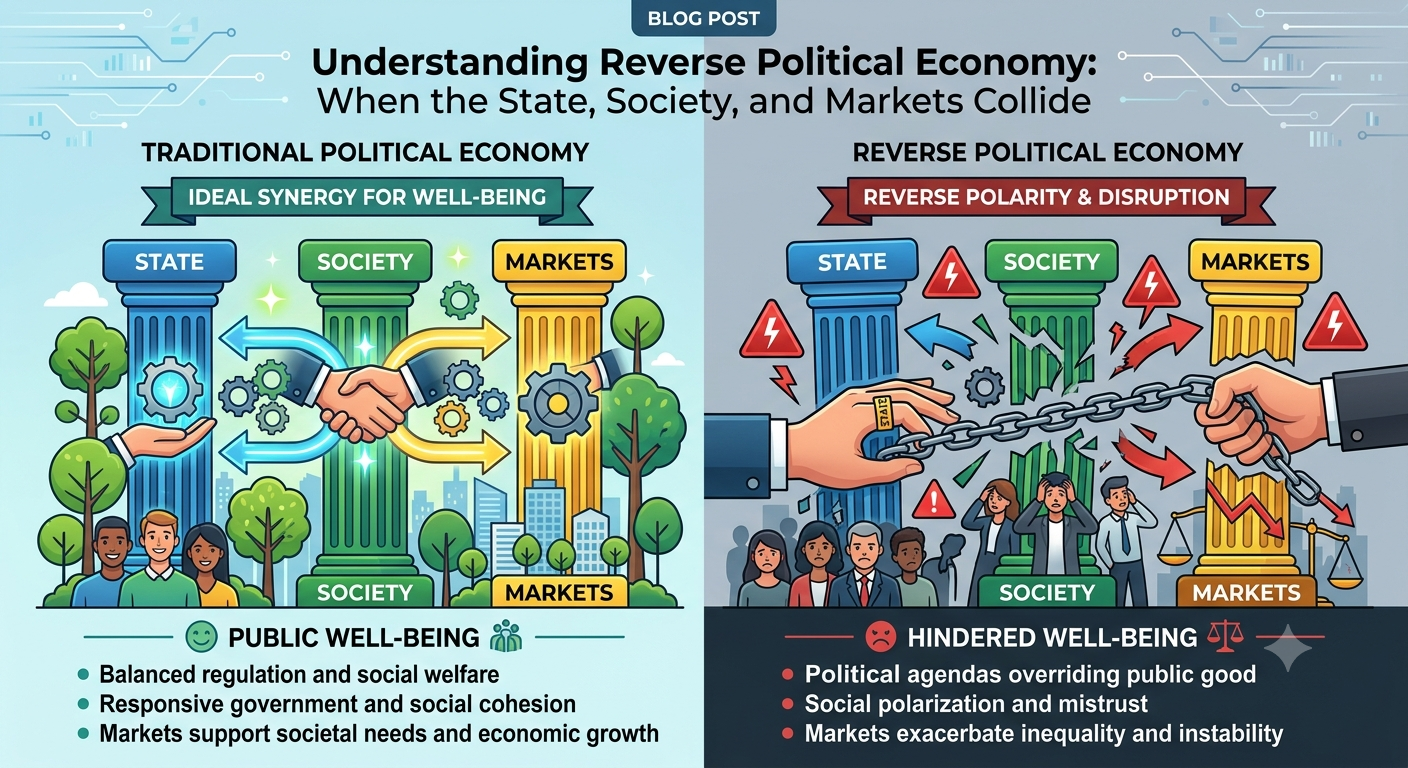
Political economy Vs Reverse political economy
Dr. Muhammad Rehman (Policy Analyst)
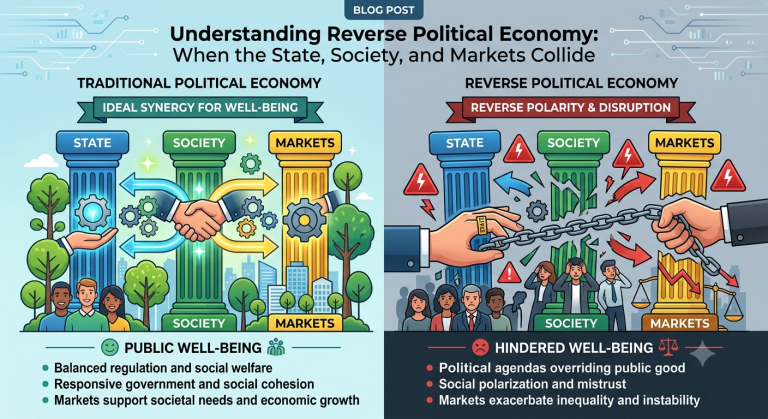
Traditionally, the political economy has been studied in relation to the interaction among the state, society and markets. Ideally, this political economy relationship is expected to promote the well-being of both the state and the general public. Generally, economic development is a process that should be used to raise citizens’ living standards and promote the provision of social services. Political economy scholars have defined mechanisms in different ways.
However, scholars generally agree that the state has a fundamental responsibility to provide essential public goods and services, including education, health, infrastructure, employment, and social welfare. J.S. MILL described political economy as the study of laws governing the production and distribution of wealth. David Ricardo elaborated political economy as the science that explains the laws determining the relationship among three major classes of society: landowners, capital owners, and labourers. Furthermore, Alfred Marshall, one of the most influential economists, described political economy as the study of mankind in the ordinary business of life. According to Marshall, it examines how individuals and society gain and use material requirements of wellbeing. Karl Marx, the father of communism, stated that political economy is the governing law that produces, distributes, and exchanges material means in human society. According to Marx, these economic laws shape social relations and determine the structure and development of society.
Traditionally, scholars use political economy to study the relationship between law, state, and economy. They examine how these interactions interact to distribute wealth and increase economic growth. In an ideal sense, governments promote the general welfare of the people. They formulate policies that improve access to education, health services, and infrastructure. Economic growth mechanisms are only desirable to the extent that they contribute to citizens’ welfare and reduce inequality.
Reverse Political Economy
In developing and developed countries, the relationship between the state, society, and the market operates differently from the traditional concept of political economy. Instead, political economy influences the interactions among these actors in the conventional manner. These actors’ interactions often shape political economy itself. In short, political economy has the reverse effect.
This blog refers to this phenomenon as the “Reverse Political Economy” effect. Under the reverse political economy, the state is primarily concerned of the state is to maximize revenue collection from its citizens rather than promoting their welfare. The government is more concerned with extracting financial resources from the population rather than providing public goods and services. The government often prioritises revenue generation over development. It delivers development through education, healthcare, infrastructure, employment and welfare services. Hence, reverse political economy as a system in which the state prioritises revenue extraction from the population. In this system, the state gives greater importance to revenue collection than to providing adequate welfare. As a result, it an unjustified imbalance between what citizens contribute in the form of taxes and bills and what they receive.
Reverse Political Economy and Development Projects
The reverse political economy is primarily concerned with increasing government revenues at all costs. As such, reverse political economy expands state infrastructure. The government spends heavily on infrastructural projects such as highways, flyovers, motorways, buildings and renovation of cities. The best case study of reverse political economy is infrastructural development projects in megacities of Punjab, Pakistan.
At the same time, the government increases the prices of goods and utilities such as electricity, groceries, medicines and fuel. To ordinary citizens, reverse political economy manifests itself through expanding government activities and rising prices of goods and services. Reverse political economy does not allow a competitive market and is continuously influencing the market through an invisible hand.
The government is also remaining reluctant to provide adequate social services to the citizens. As such, although the government is undertaking many projects that benefit the citizens, the provision of core services, such as public goods, health services and education, may continue to be lacking. These kinds of initiatives can create mistrust between the general public and government, as well as undermine trust between the government and private organizations. One example is the mistrust that has developed among the government, the public, and IPPs, where disputes over agreements, tariffs, and transparency have weakened confidence among all stakeholders.
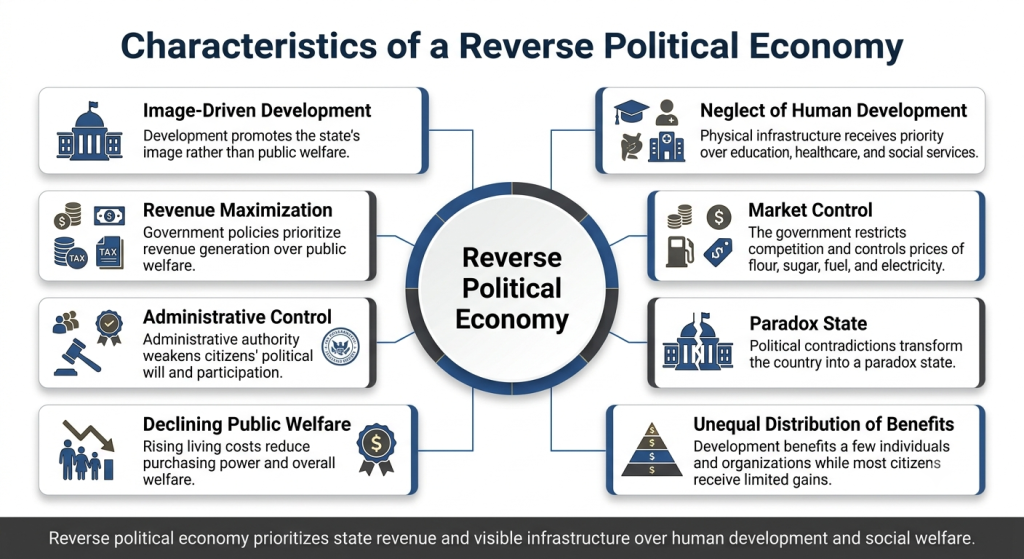
Characteristics of a Reverse Political Economy
- Development is pursued for the sake of promoting the image of the state as a progressive entity.
- The government is neglecting the development of human capital and the provision of social services in favour of physical infrastructure development.
- Policies are developed for the purpose of maximising government revenues.
- The government does not allow a competitive market and controls prices of essential goods, such as flour, sugar, fuel and electricity.
- Reverse political economy undermines the “Political Will” of the general public by exercising control through administrative powers.
- Reverse political economy also reinforces the paradoxes within the political system, thereby transforming the country into a paradoxical state.
- The general welfare of the citizens is being compromised as individuals are subjected to the rising cost of living.
- The benefits of development are accruing to a few individuals and organizations, while the majority of the citizens are being left to fend for themselves.
Reverse Political Economy and Paradox of Development
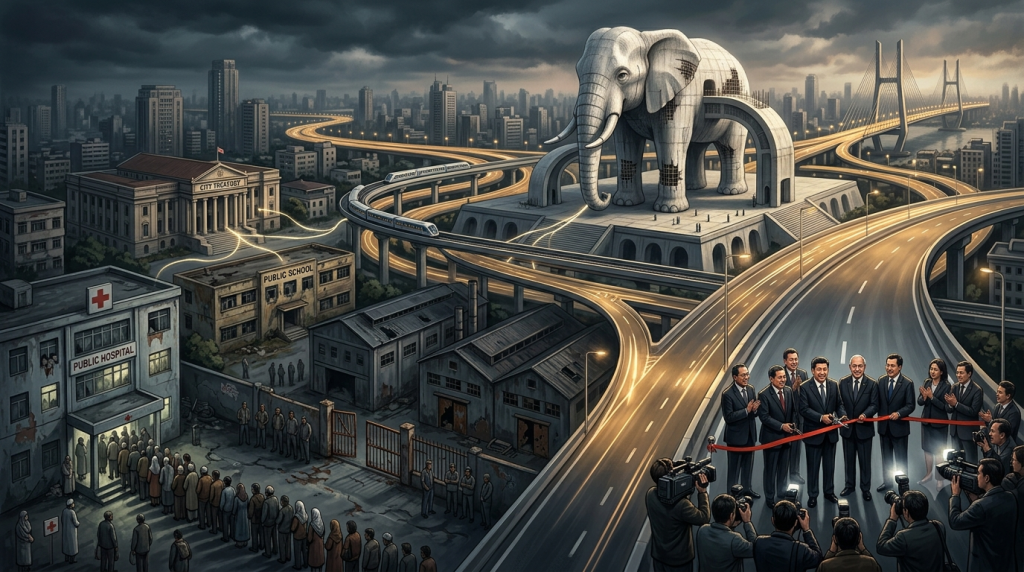
Reverse political economy is associated with what I term the “Development Paradox”. The development paradox refers to a situation in which the state promotes “Physical Infrastructure Development” at the expense of “Human Development”. Rather than investing adequately in essential public services, such as industrial development, that increase GDP and GNP, the government focuses on visible infrastructure projects, including highways, flyovers, and large-scale development. After some time, these mega development projects become white elephant projects and consume government revenue in the form of subsidy projects like the Multan Metro project in Pakistan. These kinds of projects always depend on government subsidies and never contribute to the national treasury.
Consequently, although the government may highlight its achievements in expanding physical infrastructure, it remains unable to provide adequate education, healthcare, and other essential social services. The development paradox is, therefore, a defining characteristic of the reverse political economy. These mega development projects are associated with kickbacks, bribery, corruption and the pursuit of political party interests rather than the public good.
Reverse Political Economy and Private Sector
Reverse political economy encourages the private sector to provide many of the services that the government fails to deliver. As a result, the private sector is benefiting immensely from the reverse political economy. Private sector provides services that the government fails to deliver, such as Independent Power Producers (IPPs) in Pakistan.
At the same time, the private sector remains reluctant to provide many services that require subsidies to ensure affordability. As a result, the private sector concentrates on services that generate higher profit. The private sector benefits significantly from the reverse political economy by providing services that the government fails to deliver. At the same time, it criticises the government for not providing services to the majority of the citizens. In other words, the reverse political economy creates a win-win situation for the private sector and the government while the majority of the citizens continue to suffer from the inadequate public services.
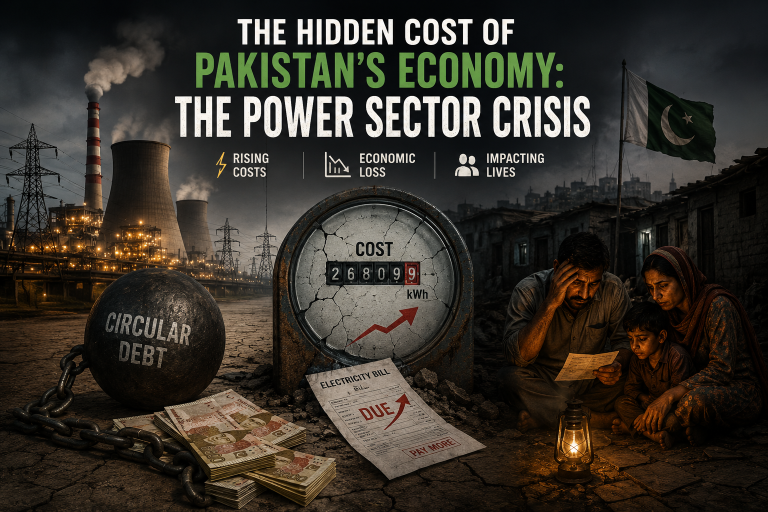
If we examine the case of IPPs in Pakistan, according to the Ministry of Energy (Power Division), circular debt was closed by the 2025 fiscal year at 1.614 trillion rupees. It further increased to 1.689 trillion rupees in the first half of FY2026. This amount equivalent to approximately USD 6.08 billion. Capacity payment for IPPs reached 3.4 trillion rupees, with per-unit costs surging to 17.31 rupees per kWh. This amount in USD reached 12.25 billion dollars. So the combined amount of capacity price and circular debt is approximately 18.33 billion dollars.
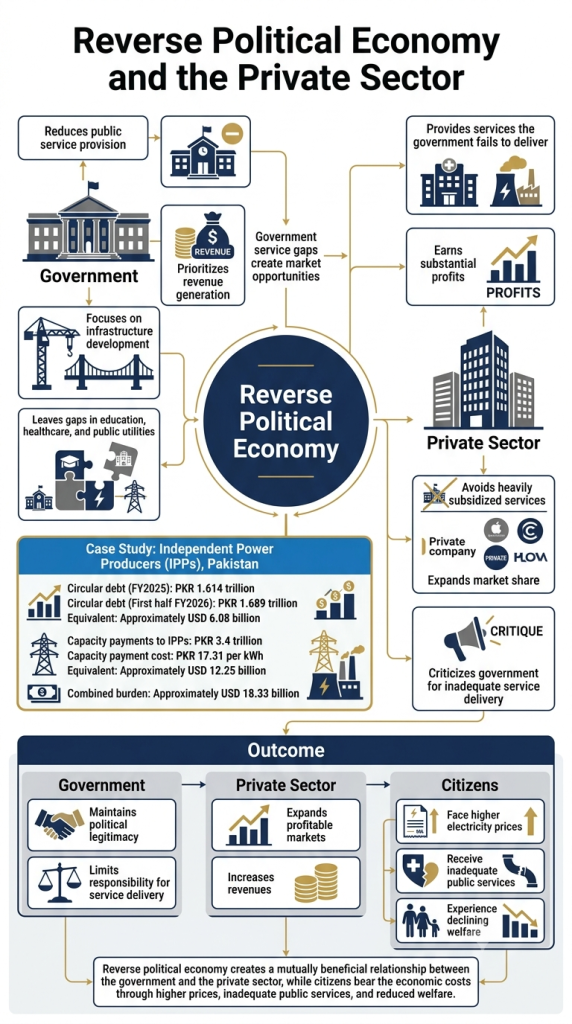
The reverse political economy is a phenomenon that has been practised in many developing countries around the world. Many governments in developing countries have been reluctant to invest in human capital development while at the same time pursuing extensive government participation in the provision of physical infrastructure. Ideally, the most effective way of promoting economic development is to encourage the private sector to provide core services such as health services, power generation, transportation and education. When the reverse political economy is practised, therefore, the private sector has an opportunity to profit from the government’s failure to provide services. As such, when the reverse political economy is practised, the private sector can benefit immensely from the situation. The reverse political economy, therefore, creates a win-win situation for the private sector and the government while the majority of the citizens continue to suffer.
Conclusion
Reverse political economy is a useful concept that helps to explain how the government can use development to promote its own interests at the expense of the majority of the citizens. The concept of reverse political economy shows that the government can use the rhetoric of development to raise revenue from the masses while at the same time benefiting a few selected elite groups.
It is important to note that reverse political economy is not always a bad thing. For instance, the reverse political economy can be used to promote the building of much-needed infrastructure such as highways and flyovers.
A country does not achieve effective development through extensive infrastructure alone. It also provides basic services, such as education and health services. In other words, governments cannot classify a country as developed without promoting social justice and human welfare. Even the most extensive infrastructure can not compensate for the absence of these fundamental elements sufficient to make a country developed.
References
- Ayana, I. D., Kebede, G. T., & Bekele, H. T. (2023). Effect of government revenue on economic growth of sub-Saharan Africa: Does institutional quality matter? Heliyon, 9 (11), e21808. https://doi.org/10.1016/j.heliyon.2023.e21808
- Britannica. (n.d.). Political economy. In Encyclopaedia Britannica. https://www.britannica.com/topic/political-economy
- Center for Global Development. (2022). Investing in human capital to attract private investment in infrastructure. https://www.cgdev.org/publication/investing-human-capital-attract-private-investment-infrastructure
- Investopedia. (n.d.). Understanding political economy: History and real-world impacts. https://www.investopedia.com/terms/p/political-economy.asp
- Marshall, A. (1890). Principles of economics. Macmillan.
- Marx, K. (1859). A contribution to the critique of political economy. Franz Duncker.
- Marx, K. (1867). Capital: A critique of political economy (Vol. 1). Otto Meissner.
- Mill, J. S. (1848). Principles of political economy with some of their applications to social philosophy. John W. Parker.
- Ricardo, D. (1817). On the principles of political economy and taxation. John Murray.
About the Author


An interesting perspective on the concept of “Reverse Political Economy.” The article raises important questions about the balance between infrastructure development and investment in human capital. While roads and mega projects are essential for economic growth, sustainable development also requires quality education, healthcare, transparent governance, and competitive markets. A balanced approach that combines physical infrastructure with social welfare is ultimately the most effective path to inclusive and long-term development.
Thanks sir, for your comprehensive review.
interesting
Thanks sir
Very nice article very informative
Dr. Muhammad Rehman’s approach towards the concept of reverse political economy is comprehensive, yet very easy to understand. He clearly explains the concept and its effects on common citizens. It’s a very interesting article
Thanks sir.
Thanks sir
Great
This is a really good and informative article i found it very helpful and used it a lot for my research paper.