Dr. Muhammad Rehman (Policy Analyst)
Globalization refers to the increase of connectivity among trade, technology, development, and economic and social change. Industrialization and rapid development around the world bring positive aspects (economic growth, development and job creation) as well as negative aspects like environmental challenges (resource depletion, pollution, emissions, and deforestation). Some supranational institutions implement policies and practices around the world to mitigate the carbon footprint and balance economic growth with environmental conservation (Nurfadhila, 2023).
Industrial countries around the world release more Geenhouse Gases (GHG), and supranational institutions impose sanctions through their policies and good practices. As a result, almost every country around the world has engaged in environmental collaborative efforts under the umbrella of environmental treaties such as the United Nations Framework Convention on Climate Change (UNFCCC), Paris Agreement (PA), Convention on Biological Diversity (CBD) and Aarhus Convention, etc. (Engelbrecht Hansen et al., 2023; Farias & Roger, 2023).
Environmental Policies/Practices and Influence on Economic Growth
In the present era, globalization, economic growth and environmental sustainability are interdependent for the prosperity of the globe. There are multiple policies (United Nations Framework Convention on Climate Change (UNFCCC), Paris Agreement (PA), Convention on Biological Diversity (CBD) and Aarhus Convention) that are implemented to protect environmental sustainability (Engelbrecht Hansen et al., 2023; Roy, 2022). There are multiple best practices that international policymakers implement along with best practices for environmental sustainability like reducing fossil fuel energy and implementing renewable energy sources, energy efficiency programs, environmental advocacy programs, hybrid transportation systems and water and biodiversity conservation (Cochran, Bird, Heeter, & Arent, 2012; Jones, Neal, Reeve, Mhurchu, & Thow, 2019). On the other side, the oligarchy of the industrialization sector focuses more on economic growth, trade and production instead of adopting best practices in their sector.
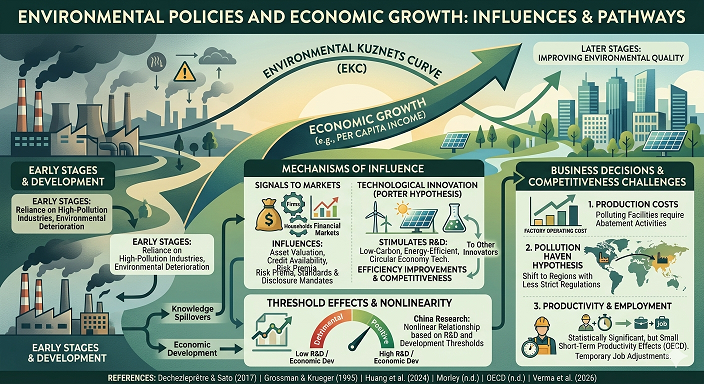
Interdependence of Financial globalization and environmental issues
Kuznets (2019) stated that the connection between the environment and economic growth has become a crucial issue for the world. Economic growth produces negative externalities for the environment as well as the nature of the world. Financial globalization which includes trade, industrialization, market and flow of capital, has both positive and negative implications on environmental policies (Kose, Prasad, Rogoff, & Wei, 2010). Business communities raise the standard of their products in response to growing worldwide competition to stay in business. By doing this, they also make improvements regarding the effects of environmental crises (such as wildfires, droughts, and increasing sea levels and temperatures) worldwide (Hasell et al., 2020).
Global governance balances economic growth and environmental sustainability
The revolutionary concept implemented by the policymakers to protect the environment and exponentially increase economic growth, thus the emerging revolutionary idea is global governance (George, 2007; Martinelli & Midttun, 2010). Under the world environmental protection strategies, supranational institutions have developed some global governance institutions worldwide, established to safeguard environmental sustainability, such as UNEP, IPCC, World Bank -environmental, Natural Resources and Blue Economy, Green Climate Fund (GCF), IUCN and Global Environmental Facility (GEF). These institutions collaborate with economic policies and best practices, and these institutions contribute to global environmental protection and sustainability without harming the economic growth of the world (Dubey, Farias & Roger, 2023; Román de Lara, 2017; Roy, 2022).
In this complex and crucial strategy of global governance interplay, the institutions, treaties, and collaborative efforts seek to establish a comprehensive framework that promotes economic development while concurrently addressing environmental challenges. Finally, the concept of global governance emphasizes the imperative to pursue growth that is both economically viable and ecologically responsible and resilient for a global future.
Global Governance Strategy
In the last two decades, global governance institutions have implemented two border (MDG and SDG) policy frameworks to tackle every aspect of life that secures the economic growth and sustainability of the world (Ashraf, Ullah, Shuvro, & Salma, 2019; Organization, 2015; Siegel & Lima, 2020). The focus of policymakers around the world has shifted to climate change, and economic growth has become the most prominent issue around the globe. The attention has been spurred by rapid industrialization, increased trade and a massive population. These factors have led to significant environmental challenges, encouraging the development of environmental policies and practices aimed at mitigating their impact. Balancing the objective of economic development with environmental sustainability has become a critical concern for policymakers and environmental actors.
In my point of view, policymakers may address these issues by adopting renewable technologies and strict implementation of policies and best practices around the world that make the prosper economic and environmental sustainability. From my point of view, global strategy is crucial when tackling the world’s financial and environmental issues. Regions, along with countries, need to work together to create effective global governance frameworks, guaranteeing concerted endeavours to alleviate climate change and safeguard ecological systems.
Aligning economic development with environmental stewardship may be achieved by adopting sustainable financial practices, such as ethical banking and green investing. Encouraging innovation in clean technology and energy efficiency is crucial for governments, corporations, and individuals to propel the shift towards a low-carbon economy. Fostering resilience and financial inclusion at the same time is essential to ensuring sustainable development for all. We have the power to create a future where environmental sustainability and economic success live peacefully via coordinated global action.
References
Ashraf, M., Ullah, L., Shuvro, M. A., & Salma, U. (2019). Transition from millennium development goals (MDGs) to sustainable development goals (SDGs): blueprint of Bangladesh for implementing the sustainable development goals (SDGs) 2030. 31(1), 46-59.
Cochran, J., Bird, L., Heeter, J., & Arent, D. J. (2012). Integrating Variable Renewable Energy in Electric Power Markets. Best Practices from International Experience, Summary for Policymakers. Retrieved from
Dubey, S. K. Climate Action and the Indian Imperative.
ELEKSIANI, A., SYAHRINA, A., SAVIRANI, A., IMELDA, A., RIFQI, A. M., NITYASARI, A., . . . PUSPITA, D. (2023). Ilmu Sosial Politik Masa Depan: Menjawab Megashift? : UGM PRESS.
Engelbrecht Hansen, A., Borgman, E., Fischer-Bogason, R., Nainggolan, D., Engen, S., Tunaal White, L., . . . Heimes, K. (2023). Synergies between climate and biodiversity objectives in laws, policies and management practices: Nordic Council of Ministers.
Farias, D. B. L., & Roger, C. (2023). Differentiation in environmental treaty making: Measuring provisions and how they reshape the depth–participation dilemma. 23(1), 117-132.
Bibliography
George, C. (2007). Sustainable development and global governance. 16(1), 102-125.
Hasell, J., Mathieu, E., Beltekian, D., Macdonald, B., Giattino, C., Ortiz-Ospina, E., . . . Ritchie, H. (2020). A cross-country database of COVID-19 testing. 7(1), 345.
Jones, A., Neal, B., Reeve, B., Mhurchu, C. N., & Thow, A. M. (2019). Front-of-pack nutrition labelling to promote healthier diets: current practice and opportunities to strengthen regulation worldwide. 4(6), e001882.
Kose, M. A., Prasad, E., Rogoff, K., & Wei, S.-J. (2010). Financial globalization and economic policies. In Handbook of development economics (Vol. 5, pp. 4283-4359): Elsevier.
Kuznets, S. (2019). Economic growth and income inequality. In The gap between rich and poor (pp. 25-37): Routledge.
Martinelli, A., & Midttun, A. (2010). Globalization and governance for sustainability. 10(1), 6-17.
Nurfadhila, M. H. (2023). Green bonds of supranational financial institutions as potential ophelimity funding for hydrogen energy development in Indonesia. Paper presented at the AIP Conference Proceedings.
Organization, W. H. (2015). Health in 2015: from MDGs, millennium development goals to SDGs, sustainable development goals. https://www.who.int/publications/i/item/9789241565110
Román de Lara, M. V. (2017). The economics of climate finance.
Roy, C. (2022). Climate finance in Asia: Assessing the state of climate finance in one of the world’s most climate vulnerable regions. Siegel, K. M., & Lima, M. G. B. (2020).
About the Author